Why it fades and other fabrics don't
Indigo is a poor dye in a useful way. It doesn't penetrate the cotton fibre; it sits on the outside of the yarn in layers, a process called ring dyeing. So each yarn is a dark shell around a white core.
Every time the surface abrades — at a knee, along a pocket edge, over a wallet — a little of that shell comes away and the white core shows. On top of that, only the warp is dyed, so the weft is white to begin with. A piece-dyed twill, coloured after weaving, cannot do any of this: it fades evenly and dully because the colour goes all the way through.
The twill matters too
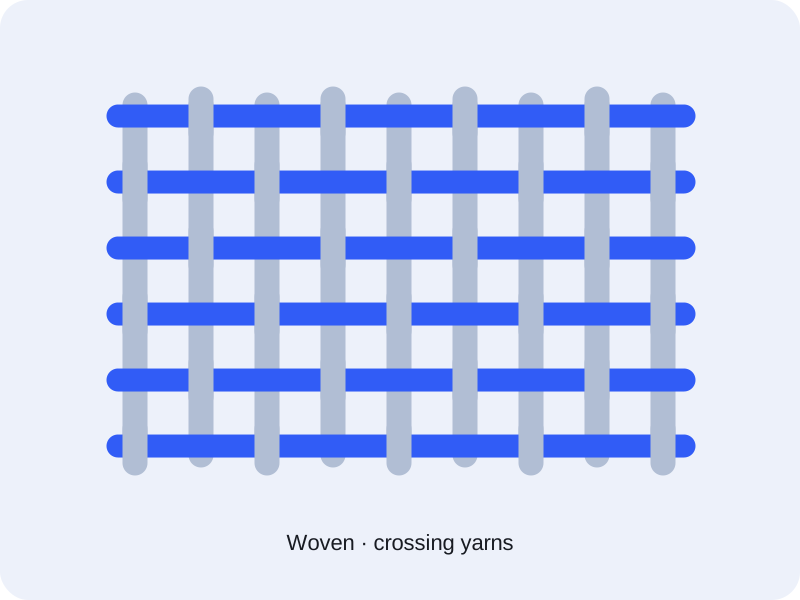
Denim is a warp-faced twill, usually 3×1: the warp crosses over three weft threads before going under one. That's why the face reads as mostly indigo and the back reads as mostly white, and why the diagonal runs the way it does.
Direction is a real spec value. Right-hand twill has the diagonal running bottom-left to top-right on the face and is the industry default. Left-hand twill runs the other way and feels softer because of how the yarn twist and the weave direction interact. Broken twill alternates, which stops the leg twisting after washing — a genuine fix for a genuine problem, and the reason it exists.
Weight, in ounces
Denim is quoted in ounces per square yard rather than g/m², which is a historical quirk you just have to convert. Multiply by roughly 34.
| oz/yd² | ≈ g/m² | Behaves like | Used for |
|---|---|---|---|
| 6–8 | 200–270 | Drapes, almost shirting | Shirts, light dresses |
| 9–11 | 305–375 | Soft, comfortable immediately | Light jeans, stretch jeans |
| 12–14 | 410–475 | Holds a shape, breaks in over weeks | The everyday jeans range |
| 15–18 | 510–610 | Stiff. Needs breaking in. | Heavyweight, raw denim |
| 19+ | 645+ | Barely bends when new | Specialist; hard on machines and seams |
Stretch denim is a different fabric
Adding 1 to 3 % elastane to the weft changes denim from a stable woven into something closer to a knit in behaviour. It fits immediately, it doesn't need breaking in, and it recovers — but it also fades differently, because the fabric moves rather than creasing in fixed places. And elastane degrades: a stretch denim has a shorter useful life than a rigid one, which is worth knowing before you spec it for a product positioned on durability.
Speccing it
- Weight in oz, and state whether it's pre- or post-wash.
- Composition, with the elastane percentage.
- Twill direction — right-hand, left-hand or broken.
- Selvedge or not. It tells you the loom, not the quality.
- Shrinkage, split length and width. Raw denim can lose 5 to 10 % in length on the first wash — this is the single biggest number in denim speccing and the one people discover the hard way.
- Wash and finish, if any, as a separate specification from the fabric itself.
Editorial page. Denim isn't in the Clothix fabric library — the current reference profiles cover knits. Wovens are a later phase, and this page exists because choosing a denim is a decision people make long before they choose a tool. What we cover and when.
Questions
Why does denim fade?
Because only the warp yarns are dyed, and indigo sits on the outside of the yarn rather than penetrating it. The weft stays white, so every time surface dye abrades away the white underneath shows through. A piece-dyed twill cannot fade this way.
What does oz mean in denim weight?
Ounces per square yard. Light denim is 8 to 11 oz, mid-weight 12 to 14, heavy 15 oz and up. Multiply by roughly 34 to get g/m², so a 12 oz denim is about 410 g/m².
What denim weight should I use for jeans?
12 to 14 oz is the everyday range and the safest first choice. Below 11 oz the garment drapes rather than holds a shape; above 16 oz it needs breaking in and puts real strain on the seams and the machines.
Selvedge denim · twill weaves · how jeans are made · weight scales compared · all fabric structures