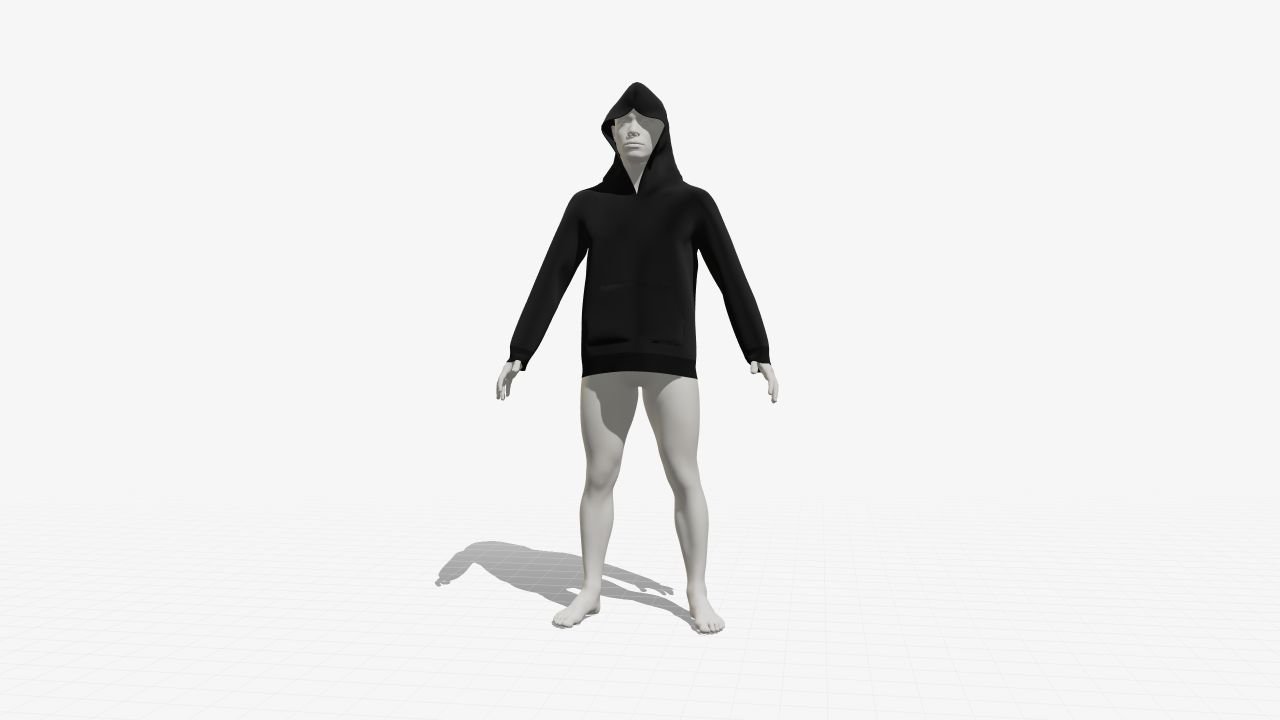
The hood: two panels or three
Two panels gives you a centre back seam and a hood that follows the head fairly closely. Cheaper, simpler, and it sits flatter on the shoulders when down.
Three panels adds a gusset strip running over the crown, which gives volume. This is why a heavy streetwear hood stands up when it's down instead of folding over — the gusset holds it. It's one more panel and one more pair of seams, so it costs slightly more to cut and sew.
Then the front edge, which is where bulk lives. Self-lined and folded back is the usual choice and gives a clean edge with somewhere solid to put the eyelets. In a 400 g/m² fleece that fold is several plies at the corner, so say what happens there or the factory decides.
Lined or unlined is a separate call. A jersey-lined hood in a fleece body needs a second fabric row in the bill of materials and changes how the hood drapes — usually for the better, always for more money.
The cord and eyelets
Six values, and this callout is usually reduced to the word "drawcord": cord diameter, cord finished length, tip type, eyelet inside diameter, eyelet material and finish, and the distance from the centre front to each eyelet.
Whether the eyelets go through the self-lined fold or through a separate reinforcement patch decides how long they last. Through two plies of heavy fleece with no reinforcement, they pull out.
The pouch pocket
Width, height, distance from the hem to the bottom edge, and the finish on the opening. Then bar tacks at both top corners of the opening — a reinforcement to discuss with the maker where repeated pulling can stress the pocket corners.
Caught in the side seams (stable, cheaper, no visible attachment at the sides) or patched onto the front (more topstitching on show, and in a heavy fabric more likely to ripple). Both are correct; only one of them is what you meant.
The ribs
Cuffs and hem, and both are stretch ratios rather than widths. Cuffs run around 65 to 75 % of the sleeve opening because they have to grip a wrist and still pass over a hand; the hem rib runs 85 to 95 % of the body sweep. The right number depends on that rib's recovery, so it gets confirmed on a sample. Recovery is the property to spec.
How to measure a hoodie
Eighteen to twenty-one points of measure, roughly twice a t-shirt. The five a hoodie adds are hood height, hood width at the opening, pocket width, pocket height and the distance from centre front to each eyelet — plus sleeve length taken to the bottom of the cuff, not to the sleeve panel edge. Where the tape goes for each.
The fabric decision that changes the season
Between 280 and 400 g/m². Below 280 the hood collapses; above 400 the corners get thick and the cuffs stop lying flat. Within that range the real choice is structure: french terry (loops uncut, springier, cooler) or fleece (loops cut and brushed, warmer, hangs heavier). Same weight, different garment, different selling season.
Where Clothix stands on hoodies: the parametric hoodie pattern exists and the hood, pocket and cuff assembly is still under review — we're checking the mesh and the seams before we'd call a hoodie tech pack production-ready. The t-shirt and crewneck are further along.
The hoodie tech pack · fleece · french terry · the crewneck it's built on · the garment catalogue