How it's made
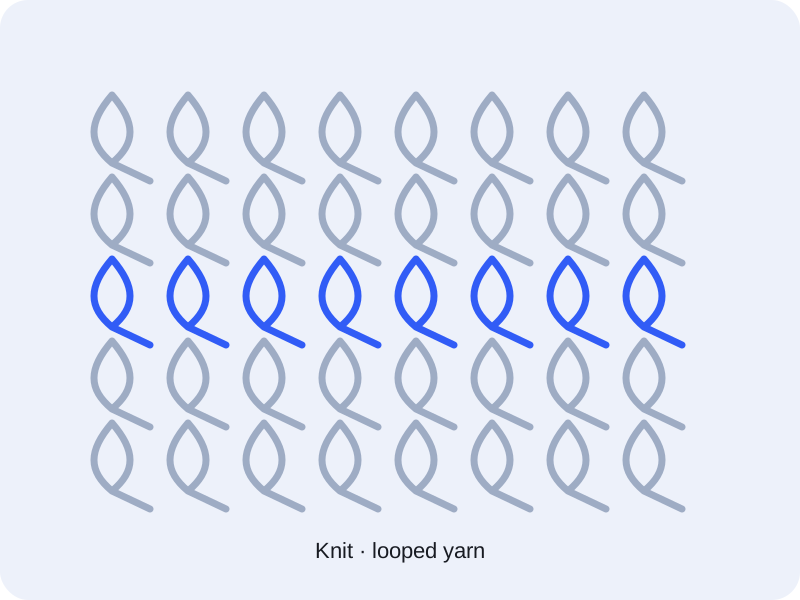
A third yarn is fed in behind the face of the knit and pulled into loops on the back. The face stays smooth, so from the outside french terry reads almost like a heavy jersey. The loops do three things: they add mass without adding much stiffness, they give the fabric more give in length than in width, and they leave the back with a slightly springy hand rather than a soft one.
The loops are also why terry is stable at a raw edge. Unlike single jersey, which curls because its face and back pull unequally, terry's extra yarn holds the structure in balance. A raw terry edge will fray slowly but it won't roll — which is why raw-hem sweatshirts work and raw-hem t-shirts mostly don't.
French terry vs fleece
| French terry | Fleece | |
|---|---|---|
| Back of the fabric | Loops, uncut | Loops cut and brushed into a pile |
| Feel at the same weight | Springier, cooler | Softer, warmer |
| Drape at the same weight | Hangs closer to the body | Hangs heavier, more volume at the hem |
| Air trapped | Less | More — the pile is the insulation |
| Pilling risk | Lower | Higher, the pile can mat |
| Seam bulk | Lower | Higher at folds and multi-layer corners |
| Usual choice for | Sweatshirts, spring hoodies, joggers | Winter hoodies, heavy sweats |
The practical version: pick terry when you want the weight without the warmth, and fleece when the garment's job is to be warm. A 320 g/m² terry hoodie is a three-season garment; a 320 g/m² fleece hoodie is a winter one.
Weights, and what each one does
| g/m² | Behaves like | Works for |
|---|---|---|
| 240–260 | A heavy long-sleeve. Drapes, doesn't hold structure. | Lightweight crewnecks, terry tees |
| 280–300 | The lower edge of a real sweatshirt. | Crewnecks; a hood at this weight sags |
| 320–350 | Holds its shape. A hood stands up when it's down. | The standard hoodie and sweat range |
| 380–400 | Structured, boxy, warm without a pile. | Heavyweight streetwear; watch cuff bulk |
| Above 400 | Very stiff. Corners get thick. | Specialist; expect construction problems |
Speccing it on a tech pack
Four things, and the last one gets forgotten:
- Structure named explicitly — "french terry", not "terry", which also means towelling with loops on both sides.
- Weight in g/m², and say whether it's the finished or greige weight. They differ.
- Composition and yarn — 100 % cotton, cotton/poly blends for reduced shrinkage, and whether it's combed.
- Shrinkage, split length and width. Terry moves mostly in length. Expect 3 to 6 % on an unwashed cotton terry unless the mill has compacted it, and get the number in writing rather than assuming.
Then remember the rib. Cuffs, neck and hem are a different fabric with a different stretch and its own row in the bill of materials — and recovery is the property that matters there.
Questions
What is the difference between french terry and fleece?
The back. French terry leaves the loops uncut, so the inside is looped and springy. Fleece cuts and brushes them into a pile, which traps air, adds loft and makes the same weight feel warmer and hang heavier.
What weight of french terry should I use for a hoodie?
Between 280 and 400 g/m² for a hoodie that holds its shape. Below 280 the hood collapses on the shoulders; above 400 the seams get bulky and the cuffs stop sitting flat.
Does french terry shrink?
Yes, and mostly in length. Expect 3 to 6 % on an unwashed cotton terry unless the mill has compacted it. Sanforised or pre-shrunk terry moves less, and the mill should state the figure.
Fleece, for comparison · what weight does and doesn't tell you · crewneck construction · hoodie construction · all five knit structures