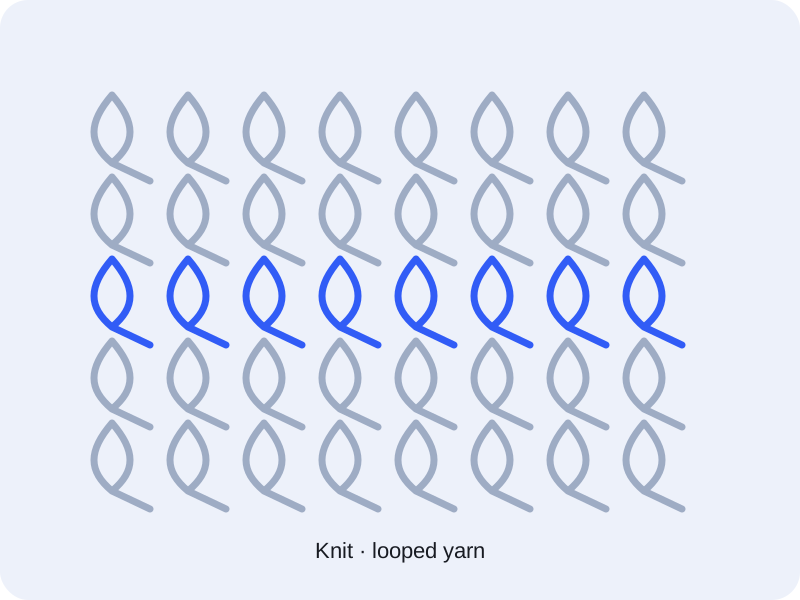
What removing the short fibres does
Smoother. Short fibres stick out of the yarn surface. Take them out and the yarn is cleaner, so the fabric feels smoother and takes print better — a fine screen print sits on a combed jersey and sinks into a carded one.
Stronger. Long fibres get more twist grip on each other. The yarn takes more tension, which means fewer breaks in knitting and a fabric that survives more washes.
Much less pilling. Pills are short fibre ends that work loose and tangle. Remove most of the short fibres and there's much less to work loose. This is the difference people notice after two months, not on the shelf.
More even colour. A cleaner, more uniform yarn dyes more uniformly, which shows most in mid-tones and heather greys.
The words that appear next to it
Three separate spec decisions get collapsed into "combed cotton" on product pages. On a tech pack they're three fields:
| Decision | Options | What it changes |
|---|---|---|
| Carding / combing | Carded · combed | Smoothness, pilling, strength |
| Spinning | Open-end · ring-spun · compact | Fineness and hand; ring-spun is finer and stronger |
| Fibre length | Upland · long staple · extra-long staple | The ceiling on all of the above |
This is why weight is a weak proxy for quality. A combed ring-spun 160 g/m² jersey will feel better and last longer than a carded open-end 200, and it costs more per metre while using less fabric per garment. What GSM does and doesn't tell you.
When it's worth paying for
Worth it: anything you're charging a premium for, anything with a fine print on it, anything in a pale or heather colour, and anything a customer will wash weekly. A t-shirt is all four.
Not worth it: a heavy fleece hoodie where the surface is brushed anyway and the pile hides the yarn, or a garment where the cost per unit is the whole proposition. Brushing changes the calculation.
Speccing it
Write all three fields: "combed ring-spun cotton, single jersey, 180 g/m²". Then ask for the yarn count, which is the number that actually pins the fineness down — a 30/1 and a 20/1 combed ring-spun make noticeably different fabrics at the same weight.
In the Clothix library the combed profile is JER-PEI-220: combed cotton single jersey at 220 g/m², the heavyweight tee entry.
Jersey structures and weights · weight and GSM · t-shirt fits · all five structures