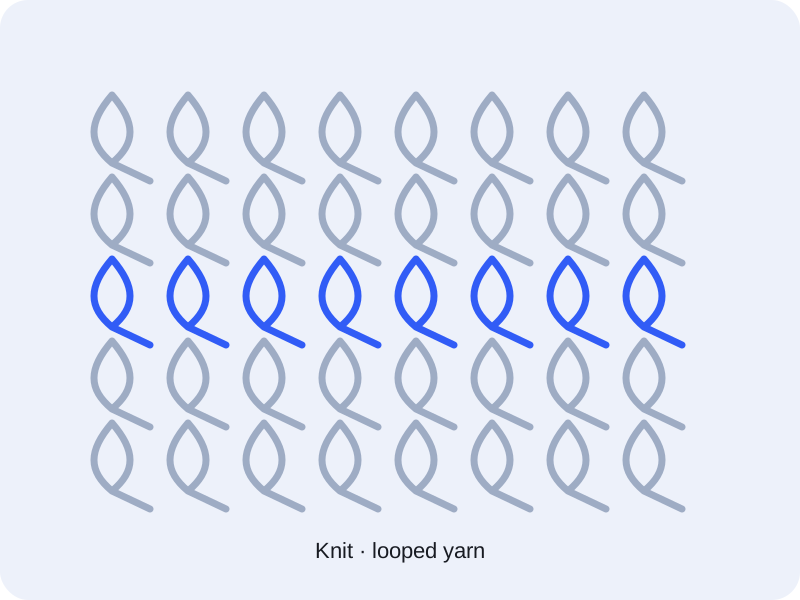
What brushing does
It traps air. The pile holds a still layer of air against the body, and that layer is the insulation — not the fibre. A brushed 320 g/m² is meaningfully warmer than an unbrushed 320, at identical weight and composition.
It adds apparent thickness without adding mass. Which is pleasant to wear and inconvenient to sew: at the point where a cuff meets a sleeve meets a side seam, you have four or six plies of a lofty fabric and the machine has to get through all of them. Heavy fleece garments get bulky corners, and it's the reason a 400 g/m² hoodie needs its allowances thought about rather than copied from a t-shirt.
It cuts the fibre ends open. Cut ends can migrate and tangle, which is pilling. A fleece will pill more than a terry of the same yarn, and a carded open-end fleece will pill considerably more than a combed ring-spun one.
It makes the fabric hang heavier. Same mass, more volume, so the hem swings more and the garment reads as substantial. That's usually what people want from a hoodie.
Weights
| g/m² | Garment | Construction note |
|---|---|---|
| 260–280 | Light sweatshirt | A hood at this weight sags onto the shoulders |
| 300–320 | The standard hoodie | Hood stands up; allowances behave normally |
| 350 | Substantial hoodie | Widely used blank weight; a useful reference point |
| 380–400 | Heavyweight streetwear | Watch cuff and pocket-corner bulk; wider hem allowance |
| Above 400 | Specialist | Expect real construction problems at multi-ply corners |
In the Clothix library
Three brushed fleece profiles: MOL-GRA-280, MOL-GRA-320 and MOL-GRA-400. Each carries its own mechanical profile, so the difference between them in the 3D view is a difference in how the garment hangs — the 400 pulls the hem down and swings less than the 280, which is what it does in fabric.
All three are brushed. Unbrushed french terry is characterised differently and is a separate entry on the roadmap; if your garment is a terry sweat rather than a fleece one, the drape you see will be slightly stiffer than the real thing.
Speccing fleece
- Say "brushed back fleece", and whether it's brushed on one side or both. Both-sided is warmer and much bulkier.
- Weight, finished, in g/m².
- Composition. Cotton-rich fleeces are softer and shrink more; polyester content cuts shrinkage and pilling and changes the hand.
- Shrinkage, split length and width. Fleece moves mostly in length, and the loops mean it can move a lot — 4 to 7 % is common on an uncompacted cotton fleece.
- Hem and cuff allowances, sized for the loft rather than copied from a lighter garment.
The comparison to make before ordering: get the same weight in brushed and unbrushed from the same mill and hold both. It's the fastest way to understand what the pile is doing, and it's a decision that changes what season your garment sells in.
French terry, unbrushed · weight and GSM · hoodie construction · the hoodie tech pack · all five structures