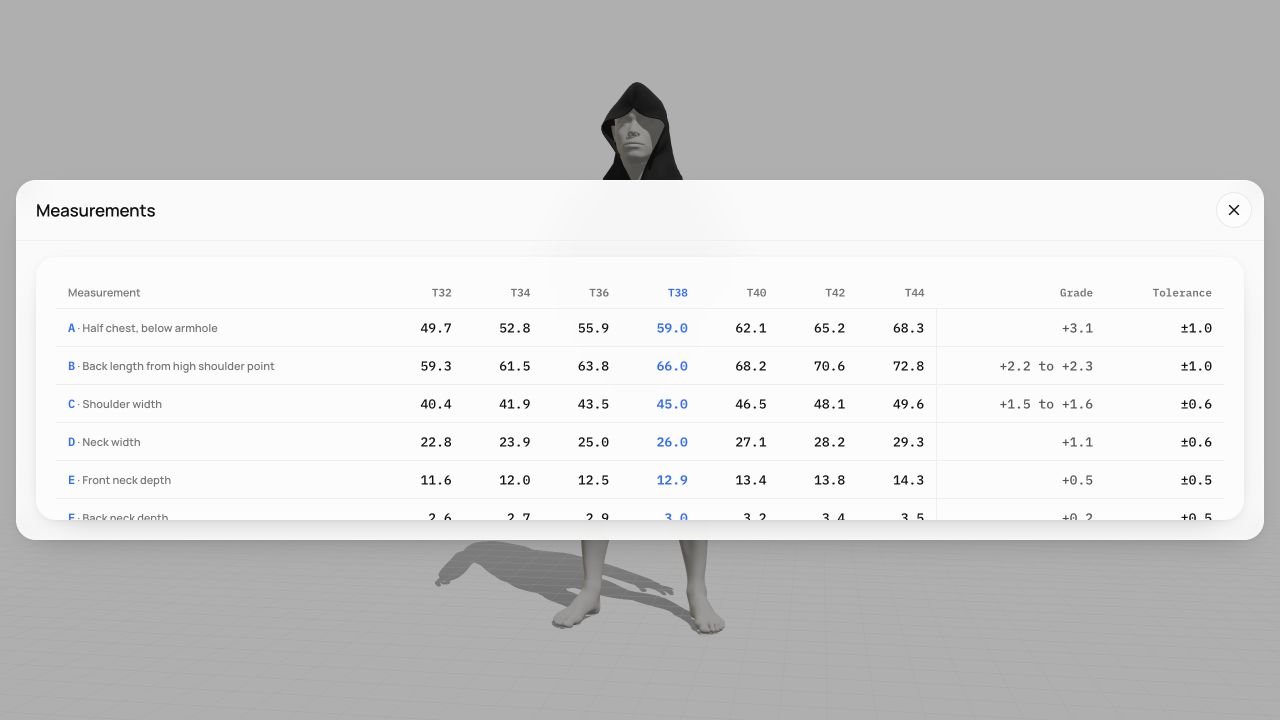
The eleven points of measure
| Point of measure | How to measure | Typical M | Tol. |
|---|---|---|---|
| Chest | 2.5 cm below armhole, laid flat, doubled | 52 cm | ±1 |
| Body length | High point of shoulder to hem, front | 71 cm | ±1.5 |
| Shoulder to shoulder | Seam to seam across the back | 45 cm | ±0.5 |
| Sleeve length | Shoulder seam to sleeve opening edge | 21 cm | ±0.5 |
| Sleeve opening | Flat, doubled | 18 cm | ±0.5 |
| Armhole | Straight, shoulder seam to side seam | 23 cm | ±0.5 |
| Neck width | Seam to seam, inside edge of rib | 18 cm | ±0.5 |
| Front neck drop | Shoulder seam line to inside of rib at CF | 7 cm | ±0.3 |
| Back neck drop | Shoulder seam line to inside of rib at CB | 2 cm | ±0.3 |
| Neck rib width | Finished, folded | 1.8 cm | ±0.2 |
| Bottom hem depth | Finished turn-up | 2 cm | ±0.3 |
Add sweep (hem width) as a twelfth if the body is shaped rather than straight. On a straight-side tee, sweep equals chest and writing both invites them to disagree.
The rib decision
A neck band is cut shorter than the opening it goes into, then stretched on. The ratio between the two is the single most consequential number on a t-shirt tech pack, and it's the one most often left off.
Around 85 to 90 % of the neck opening length is the usual range for a 2×1 rib. Cut it at 100 % and the neck ripples and eventually gapes; cut it at 75 % and the neck puckers and won't go over a head. The right figure depends on the rib's recovery, which is a property of that specific rib and not of ribs in general. What changes between a 1×1 and a 2×1.
Also specify: rib composition and weight (it's a different fabric from the body), whether the seam is closed on the shoulder or at the back neck, and whether there's a back neck tape. Tape costs almost nothing and stops the shoulder line stretching out — leave it off and the tee grows sideways at the top over a year.
The fabric row
Composition, weight, structure, and finish. Single jersey at 140 to 160 g/m² for lightweight, 180 for the everyday middle, 200 to 220 for something that reads heavyweight. Above 220 and you're usually looking at interlock or a double knit, which behaves differently at the hem.
Then yarn: combed ring-spun versus carded open-end changes the hand and the pilling more than 20 g/m² of weight does. And shrinkage, stated separately for length and width, because it has to be added into the pattern rather than hoped away.
Construction callouts
- Shoulder seams — overlocked, taped, allowance 6 mm.
- Side seams — overlocked, 6 mm. Say whether it's a side-seamed or tubular body; tubular is cheaper and has no side seam to spec.
- Armholes — set-in sleeve overlocked; state whether the seam is pressed toward the sleeve or the body.
- Neck — rib attached with an overlock, then topstitched or cover-stitched down. Say which; they look different from the outside.
- Hem and sleeve openings — turned and cover-stitched or twin-needled, allowance 20 mm for a 2 cm finished hem plus the fold.
Artwork placement
From the back neck seam down the centre front, not from the hem. A standard chest print sits with its top edge 7 to 9 cm below the neck seam; a full front sits 12 to 15. Give the print's finished width and the ink count, and if it crosses a seam say so explicitly, because most printers will refuse or charge for it.
Boxy, drop shoulder and oversized as pattern decisions · the hoodie version · how to take each measurement · what a tech pack contains