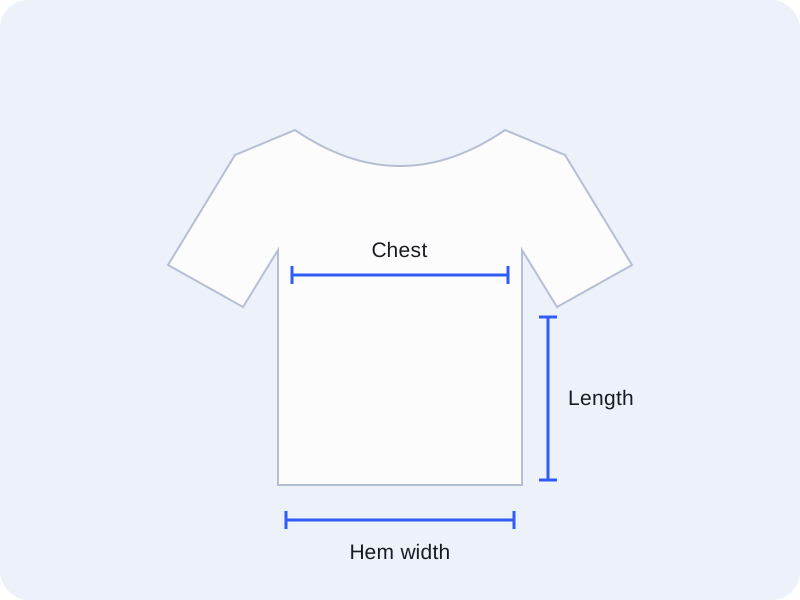
Set-up
Flat surface, garment unstretched, seams straight, no folds trapped underneath. Smooth it with your hands rather than pulling it — a knit will happily give you 2 cm you didn't mean to ask for. Measure the same garment twice on different days and you'll see your own repeatability; if the two readings differ by more than the tolerance you're planning to write, the tolerance is too tight.
Every point of measure needs two things written down: where the tape goes, and whether the value is doubled. "Chest 52 cm" is ambiguous — half-chest measured flat, or the full circumference? Say which. Convention on a knit top is flat-and-doubled, but convention is what causes the arguments.
The points, for a knit top
How to measure a t-shirt, a sweatshirt or a hoodie comes down to the same sixteen rows. The garment changes which of them you need, not what they mean.
| Point of measure | Where the tape goes | Tol. |
|---|---|---|
| Chest | 2.5 cm below the armhole seam, straight across, flat, doubled | ±1 |
| Waist / sweep | At the narrowest point, or at the hem for a straight body, flat | ±1 |
| Body length, front | High point of shoulder straight down to the bottom edge | ±1.5 |
| Body length, back | Centre back neck seam down to the bottom edge | ±1.5 |
| Shoulder to shoulder | Shoulder seam to shoulder seam across the back | ±0.5 |
| Shoulder slope | Vertical drop from neck point to shoulder point | ±0.3 |
| Sleeve length | Shoulder seam to the sleeve opening edge, along the fold | ±0.5 |
| Sleeve length from CB | Centre back neck to sleeve opening, for raglans and drop shoulders | ±1 |
| Bicep | 2.5 cm below the armhole, flat, doubled | ±0.5 |
| Sleeve opening | Flat, doubled | ±0.5 |
| Armhole, straight | Shoulder seam to side seam in a straight line | ±0.5 |
| Neck width | Seam to seam at the inside edge of the band | ±0.5 |
| Front neck drop | Shoulder seam line down to the inside of the band at CF | ±0.3 |
| Back neck drop | Shoulder seam line down to the inside of the band at CB | ±0.3 |
| Neck band width | Finished, folded | ±0.2 |
| Hem depth | Finished turn-up or rib height | ±0.3 |
Tolerances, and why zero is worse than wide
A tolerance says how much variation gets accepted before a piece is rejected. It's not a confession of imprecision; it's the number that makes acceptance decidable.
Fabric relaxes on the cutting table, shrinks in finishing and stretches under a machine foot. The ranges above are ordinary for knits. Tighten a chest to ±0.2 cm and one of two things happens: the factory declines the job, or it accepts and then ships pieces outside the spec because nobody can hold it, and now your quality process is fiction.
Wider than the ranges above is also a decision — a ±2 cm chest on a boxy tee is genuinely fine, and saying so up front buys you goodwill and a better price.
Turning one size into a chart
Fill in the base size completely, then express the other sizes as grade rules rather than typing them. A chart with five hand-typed size columns will eventually contain two columns that disagree with the pattern, and you won't find out until an XL comes back wrong. A rule per point of measure.
Measuring a garment you already own
The single cheapest and most reliable way to get a base size: buy a garment whose fit you know works, and measure it. You get real numbers, from a real garment, with no invention involved.
Two adjustments before you use them. First, if it's been washed, you're measuring post-shrinkage — so either add the shrinkage back or state your chart as post-wash and tell the factory. Second, if the fabric you're specifying differs in weight or structure from the reference, expect a different hang from identical numbers: a 220 g/m² jersey at the same measurements as a 160 will read as a squarer garment.
Where Clothix does this differently
Clothix brings the selected garment and its technical details into the same project. Review the available measurements and outputs in the application, and confirm that the version sent to your maker matches the design you approved. How the pattern stays the source.
The blank chart to fill in · grading it to other sizes · t-shirt values for orientation · what changes between fits · all guides