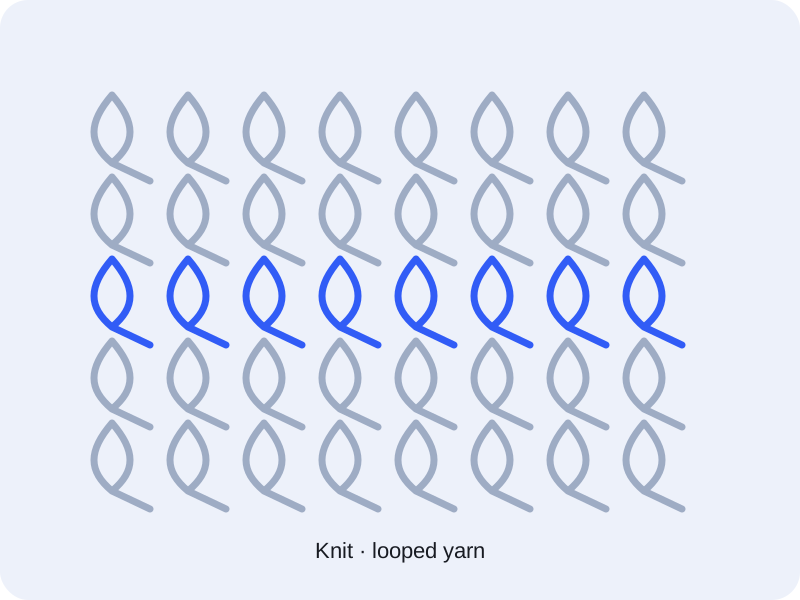
Why it curls
A single knit isn't balanced. The loops pull the face and the back of the fabric by different amounts, so a cut edge relieves that tension by rolling — toward the face at a crosswise cut like a hem, toward the back at a lengthwise one. It isn't a defect and no finishing fixes it; it's the structure.
The consequence for construction is that jersey edges always get treated. A hem is turned and cover-stitched or twin-needled. A neckline gets a rib band or a binding. A sleeve opening gets the same. If you want a raw edge on a knit garment, you want terry or interlock, not jersey.
Weights, and what each one is for
| g/m² | Reads as | Watch out for |
|---|---|---|
| 120–140 | Very light, drapey, summer | Translucent in white and pale colours |
| 150–170 | Standard light tee | Shoulder seams can stretch; tape them |
| 180–190 | The everyday middle | Nothing much — this is the safe default |
| 200–220 | Heavyweight. Holds a boxy shape. | Neck ribs need to be heavier to match |
| Above 220 | Usually interlock or double knit instead | A single jersey this heavy hems thickly |
The variants worth knowing
Combed vs carded. The single biggest quality difference at the same weight. Combing removes the short fibres before spinning, giving a smoother, stronger, less-pilling yarn. What it removes and what it costs.
Ring-spun vs open-end. Ring-spun twists the fibres into a finer, stronger yarn; open-end is faster and cheaper and feels coarser. A combed ring-spun 160 will feel better than a carded open-end 200, which is why weight alone is a poor proxy for quality.
With elastane. Two to five per cent elastane gives the fabric recovery — it returns to shape instead of growing. You need it for fitted patterns and for anything with zero or negative ease, and you don't need it for a boxy tee, where it just adds cost.
Slub. Deliberately uneven yarn, giving a textured surface. It's a look, and it complicates colour matching between dye lots.
Jersey in Clothix
Use the reference fabric profiles available for the garment selected in the application. Their parameters are estimates for exploring a design direction; they are not laboratory measurements of the fabric you will buy.
Compare structure and weight, then confirm composition, shrinkage and behavior against your supplier's fabric and a physical sample. The editorial library describes materials beyond the currently supported simulation profiles. Understand the 3D drape preview.
Speccing jersey on a tech pack
Five fields. Structure ("single jersey"), weight in g/m², composition with the elastane percentage if any, yarn spec (combed or carded, ring-spun or open-end), and shrinkage split into length and width. A row that says "180 g/m² cotton jersey" is missing the two fields that decide the hand.
Then the rib for the neck, separately — it's a different fabric and it needs a stretch ratio, not just a width.
Questions
Why does jersey curl at the edges?
Because a single knit is not balanced. The loops pull the face and the back by different amounts, so a raw edge rolls toward the face at the hem and toward the back at the selvedge. It's not a fault; it's the structure, and it's why jersey hems are turned or banded.
What jersey weight makes a good t-shirt?
140 to 160 g/m² for a light summer tee, 180 for the everyday middle, 200 to 220 for something that reads as heavyweight and holds a boxy shape. Above 220 you're usually in interlock or double-knit territory.
Is jersey the same as t-shirt fabric?
Nearly always, yes. Most t-shirts are single jersey. The phrase "t-shirt fabric" hides real differences in weight, yarn and finish, which is exactly what a tech pack has to pin down.
Weight and GSM · combed cotton · interlock, which doesn't curl · t-shirt fits · the t-shirt tech pack · all five structures