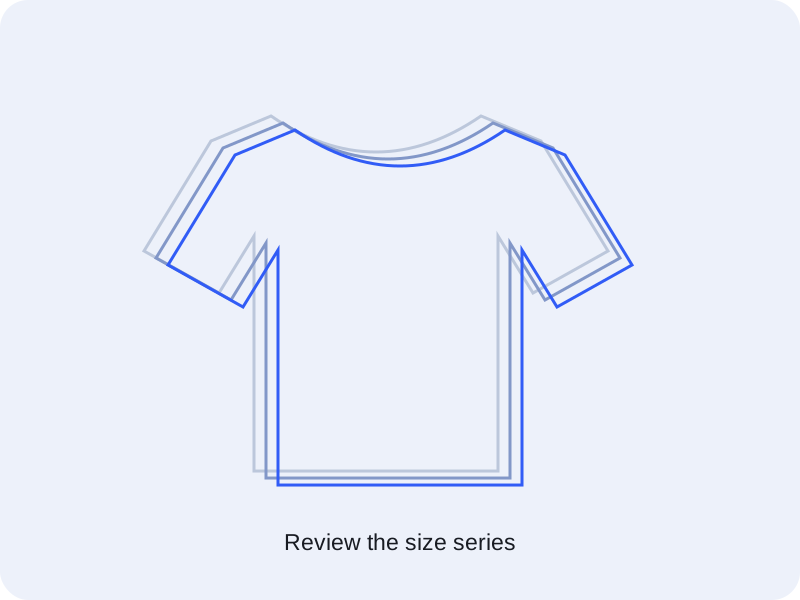
What a grade rule is
A number, per point of measure, per size step. "Chest +5 cm per size" means each size up adds 5 cm to the full chest — so 2.5 cm on the flat half-chest, split between the front and back panels, which is 1.25 cm per side seam. That arithmetic is where errors hide.
A grade rule set for a knit top is typically ten to sixteen lines. It's small, it's reusable across every style with the same body type, and writing it once is the highest-leverage hour in the whole process.
Indicative rules for adult knit tops
| Point of measure | Per size step | Why |
|---|---|---|
| Chest, full | +4 to +6 cm | The main driver; 5 cm is the common middle |
| Sweep / hem, full | +4 to +6 cm | Usually tracks the chest on a straight body |
| Body length | +1.5 to +2 cm | Torsos lengthen slowly relative to width |
| Shoulder to shoulder | +1 to +1.5 cm | Slower than the chest — this is the rule most often got wrong |
| Sleeve length | +0.6 to +1 cm | Arms lengthen slowly; over-grading gives sleeves past the knuckles |
| Bicep | +1 to +1.5 cm | Tracks the chest at roughly a quarter of the rate |
| Sleeve opening | +0.5 to +0.8 cm | Slowest of the sleeve measures |
| Armhole depth | +0.6 to +1 cm | Follows the chest, but not proportionally |
| Neck width | +0.3 to +0.6 cm | Necks barely grow. Grading them like chests is visible immediately. |
| Front / back neck drop | +0 to +0.2 cm | Often held constant across the middle sizes |
| Band and hem widths | +0 | Trims don't grade. A 1.8 cm neck rib is 1.8 cm in every size. |
The three places a grade goes wrong
Trims graded along with the garment. A neck rib width, a hem depth, a pocket size, an eyelet diameter — these are absolute. Scale them and your XXL has a 2.4 cm neck band that reads as a mistake, because it is one.
Shoulders graded at the chest rate. The commonest error and the most visible. Shoulders grow at roughly a quarter of the chest rate; grade them at the full rate and the largest sizes have shoulder seams hanging off the arm — which, confusingly, looks like a drop shoulder and isn't one. The difference matters.
Grading before the base size is approved. Every rule is expressed relative to the base. Change the base after grading and you regrade — so the base gets frozen and sampled first. It's gate three for a reason.
Where the size run stops working
A single rule set holds for three or four sizes either side of the base. Push it to seven and the extremes stop fitting real bodies, because the shape of the body changes and not just its dimensions — which is why extended ranges usually get a second base pattern rather than a longer grade.
Our view: for a first production run, grade three sizes and sell them. Adding the tails once you know the demand curve is cheap; owning unsold XS and 3XL is not.
Reading a nest
A nest is every graded size of one pattern piece drawn on top of each other, sharing a reference point. It's the fastest way to check a grade: the lines should fan out evenly, and any two lines that cross or bunch mean a rule is wrong. It takes a few seconds to read and catches errors a table of numbers hides.
Clothix draws the nest with a millimetre rule on the sheet, so the grade can be checked at a glance and the scale can be verified by anyone holding a printout. Patterns and grading in the tool.
Grading and the measurement chart
They're the same information twice, which is why they drift apart. The chart says what each size measures; the pattern makes it so. Keep them derived from one source, or accept that you'll be reconciling them by hand after every revision. How to build the base chart.
The base measurement chart · grading in Clothix · production CAD for grading · where the grade sits in a tech pack · all guides