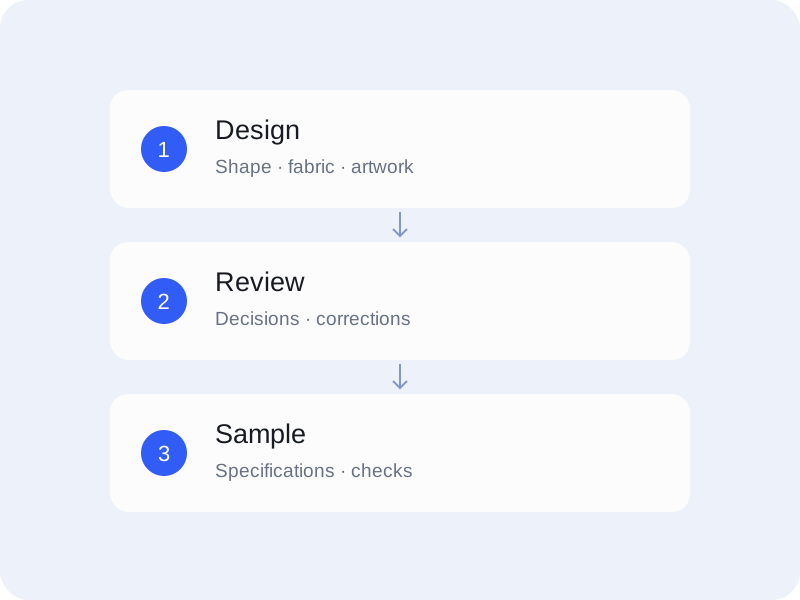
Start with one garment. Not a collection.
This is the one strong opinion on the page, so it goes first: make one style, in one colour, properly, and treat everything else as later. A three-piece capsule triples your minimums, triples your fabric commitments and triples the number of things that can be wrong when the samples land — and you'll learn nearly everything from the first one.
The condition that would change our advice: if you're producing with a private-label factory that already makes the garment and only puts your label in it, minimums are low enough that three styles at once is survivable. If anyone is cutting a pattern for you, make one.
Gate 1 — Can you describe the garment in numbers?
Before money moves, write the spec. Not a mood board — a measurement chart, a fabric with a weight and a structure, and a list of every seam and finish. What a tech pack has to contain is the whole checklist; the blank template is free.
The fastest honest route to real numbers: buy a garment you like the fit of, lay it flat, and measure it. Every point of measure, with the tape placement written down. That's a base size in an afternoon, and it's more reliable than any number you'd invent. Point by point.
Gate: if you can't fill the measurement chart and the bill of materials, you can't get a quote — and factories that quote anyway are quoting on their garment, not yours. Cost of stopping here: nothing.
Gate 2 — Does a factory want the job?
Now send the spec out, to more places than feels necessary. Ten enquiries producing two replies is normal, and the two that reply are selecting you as much as the reverse: a small first order from an unknown brand is a poor use of a sample room's week, and they know it.
What decides the shape of everything after this is which of three arrangements you end up in:
| Arrangement | You supply | Typical MOQ | Pattern owned by |
|---|---|---|---|
| Private label | Artwork and a label | 50–100 / colour | Them — it's their garment |
| Cut and sew | Pattern, spec, sometimes fabric | 100–300 / colour | Whoever drafted it |
| Full package (FPP) | Spec and a sketch | 200–500 / colour | Them, usually |
Gate: get the MOQ, the price per unit at that MOQ, the sample cost and the lead time in writing before you commit to a fabric. If the MOQ is above what you can sell, stop and find another factory — this is the single most common place first brands over-commit.
Gate 3 — Does the sample match the spec?
The sample arrives. Do not try it on and decide how you feel about it. Measure it first, against your own chart, point by point, and write the deviations down.
Two different problems hide in a sample that feels wrong, and they have opposite fixes:
- It doesn't match the spec. The factory made it wrong, or your callouts were ambiguous. Fix the tech pack, don't change the design.
- It matches the spec and the spec was wrong. Your numbers were off. Change the numbers, and expect to.
Almost everyone's first sample is the second case, and it's the whole reason the sample exists. Budget for two rounds. One is optimistic; three means something in the spec is unclear rather than wrong, and it's worth reading your construction callouts again for the word "standard".
Gate: a sample that matches a spec you're happy with. Not "close enough" — every millimetre you accept here gets multiplied by your order quantity.
Gate 4 — Can you sell it before you own it?
Here's where we'd break with the usual advice. The conventional order is: produce, then sell. The order that has ruined more first brands than any other is: produce a size run in three colours, then discover which one people wanted.
If your arrangement allows it, sell first — pre-orders, a small drop, a made-to-order window. It's slower, it converts worse, and it tells you the one thing no amount of planning does: which size and colour people actually buy. If your MOQ makes that impossible, then at minimum weight your size run toward the middle sizes and your colour split toward one colour.
Gate: a number of units you'd be comfortable owning for a year. Whatever that is, that's your first order.
The dead end worth naming
The trap that catches people between gates 1 and 2 is trying to solve the pattern problem by finding a free pattern online. Free sewing patterns exist in abundance and they're for home sewing: 15 mm seam allowances, no grade rules, no industrial machine callouts, and no DXF. A factory can work from one, and what it will do is re-pattern the garment and charge you for it — at which point the pattern belongs to them.
The real options are: pay a pattern maker once (a few hundred, and the right answer for an unusual garment), learn to draft (months, and the skill outlives every tool), or use a tool where the pattern is generated from the garment (which is what we build, and it only covers knit tops).
What we'd skip, having watched people do it
- A logo design process before the garment exists. The garment is harder and takes longer. A wordmark in a good typeface is enough for the first run.
- Custom woven labels on the first order. They carry their own minimums, often in the thousands. Printed labels first.
- A full size run. Middle sizes first. You can add the tails once you know the curve.
- A photoshoot before the sample is approved. Every fit change makes the shots wrong.
- Company formation before you have a garment. Real in some jurisdictions, worth doing before you sell, not before you spec.
What it costs
Two places the total swings by a factor of ten: whether you pay for patternmaking, and what MOQ you accept. Everything else is comparatively predictable. Line by line, with the ranges and their conditions.
The order, in one list
- Pick one garment.
- Measure a reference garment you already own.
- Write the spec: measurements, tolerances, fabric, seams, finishes, trims.
- Get the pattern — paid, drafted, or generated.
- Send the spec to ten factories.
- Compare MOQ, unit price, sample cost and lead time in writing.
- Order one sample.
- Measure it against the chart. Revise. Repeat once.
- Approve, then grade the pattern.
- Sell what you can before you order what you can't return.
What it costs · finding a factory · what a tech pack contains · choosing a fabric · how Clothix fits into this · all guides