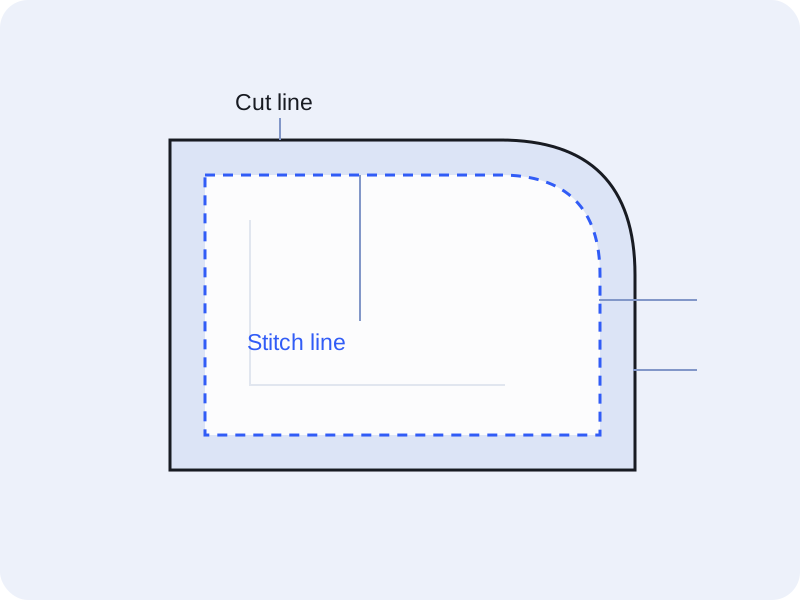
Why there's no standard
People look for "the standard seam allowance" and find two different answers, both correct in their own world.
Home sewing patterns use 15 mm (5/8 inch), and have for decades. The reason is correction: a generous allowance lets a home sewer take a seam in or let it out after a fitting. It's a hedge, and it's the right one when there's one garment and no grader.
Industrial knitwear uses 6 mm on an overlock, because the machine trims as it sews and there's nothing to correct — the pattern was graded and the fit was settled on a sample. Fifteen millimetres on an overlock is just fabric being cut off and thrown away, times your order quantity.
So the question isn't what the standard is. It's which machine is doing the seam.
Widths by seam and machine
| Seam | Machine | Allowance | Note |
|---|---|---|---|
| Shoulder, knit | Overlock, taped | 6 mm | Tape stops the shoulder line growing |
| Side seam, knit | Overlock | 6 mm | Trimmed as sewn |
| Armhole, set-in knit | Overlock | 6 mm | State which way the seam is pressed |
| Neck band attach | Overlock | 6 mm | Then topstitched or cover-stitched down |
| Hem, turned | Cover stitch / twin needle | 20–25 mm | For a 20 mm finished hem plus the fold |
| Hem, heavy fleece | Cover stitch | 25–40 mm | Wider so the fold doesn't bulk under the foot |
| Side seam, woven | Lockstitch | 10–15 mm | Then finished separately — the edge doesn't self-trim |
| Flat-felled | Lockstitch, twice | 15–20 mm | One side is folded over the other |
| French seam | Lockstitch, twice | 15 mm total | Roughly 5 mm then 10 mm; the total is what you cut |
| Binding, self-fabric | Binder attachment | 0 mm on the body | The binding carries the allowance, not the panel |
What the fabric changes
Fraying fabrics need more. A loose weave or a fabric with a slippery yarn pulls out of a narrow seam. More allowance, or a seam type that encloses the edge.
Stable fabrics need less. Interlock doesn't curl and doesn't fray much, so a narrow allowance holds.
Thick fabrics need more at folds, not at joins. A 400 g/m² fleece is fine at 6 mm on an overlocked side seam and needs a wider hem allowance so the turn-up doesn't build into a ridge the machine fights.
High-stretch fabrics need the seam to stretch, not the allowance to grow. That's a stitch choice — overlock or cover stitch, not lockstitch — and adding allowance doesn't help.
Two things that go wrong
A pattern with no allowance sent to a factory. A net pattern — outlines with no allowance — is a legitimate way to work, and a factory that assumes otherwise will cut a garment a centimetre small on every seam. Whether allowance is included has to be stated on the pattern, in words, in a place nobody can miss.
Allowance included on some pieces and not others. Worse, because it looks fine. It happens when a piece gets redrawn mid-project. The graded nest catches it: a piece whose allowance is missing sits visibly inside its neighbours' fan. Reading a nest.
Writing it on a tech pack
Per seam, not once for the garment. A row per seam with the machine, the stitch, the allowance and the thread. This is the same walk-the-perimeter pass that catches unassigned edges — every edge is seamed, finished or folded, and each of the three has an allowance consequence. Step five.
Questions
What is a seam allowance?
The strip of fabric between the cut edge and the stitch line. It's what the machine consumes to join two pieces, and it's why a pattern piece is always bigger than the finished panel.
What is the standard seam allowance?
There isn't a single one. Industrial knitwear runs 6 mm on an overlock, 10 mm on a lockstitch side seam, 20 to 40 mm on a turned hem. Home sewing patterns default to 15 mm (5/8 inch) because the machines and the corrections are different.
Does seam allowance change with the fabric?
Yes. A loose or fraying fabric needs more so the seam doesn't pull out; a stable interlock needs less. A thick fleece needs a wider allowance at the hem so the fold doesn't bulk up under the cover stitch.
Glossary of construction terms · how allowances sit on the pattern · writing the construction sheet · bindings on a curved edge · all guides